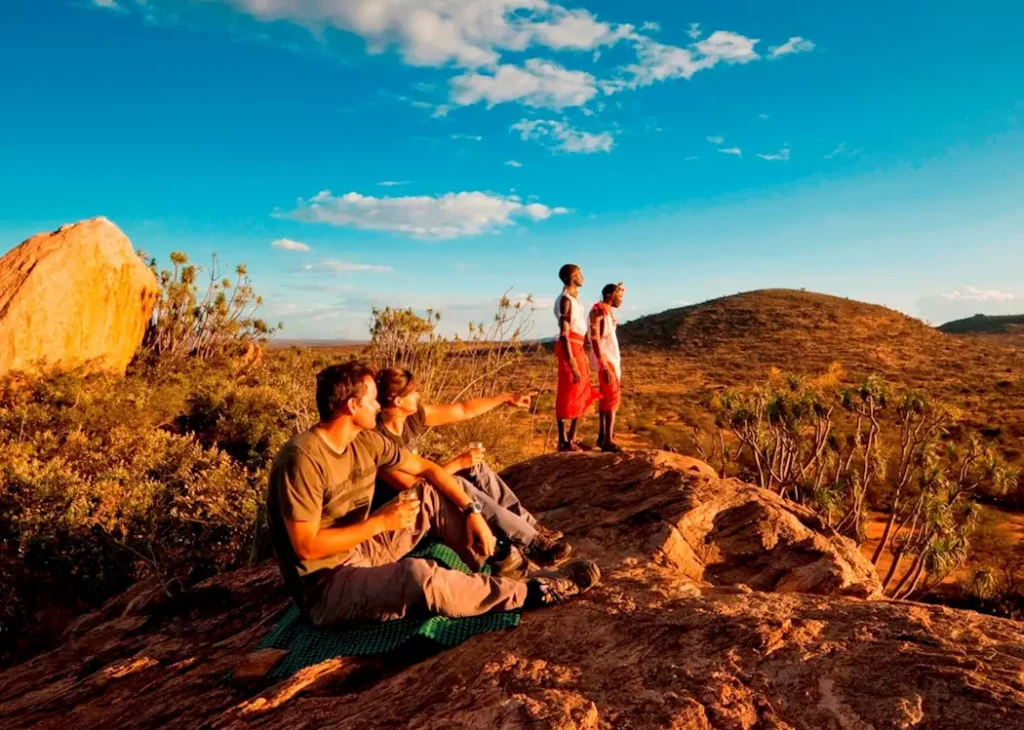
What to Do on the Laikipia Plateau: Experiences You Cannot Have in the Mara.
The defining advantage of Laikipia is freedom of movement: because the conservancies are private, guides can offer activities that are restricted or prohibited inside Kenya’s national parks and reserves. The following are the ones our guests ask about most, with real prices from Loisaba’s published extras so you can budget realistically.
Walking Safaris and Rhino Tracking on Foot
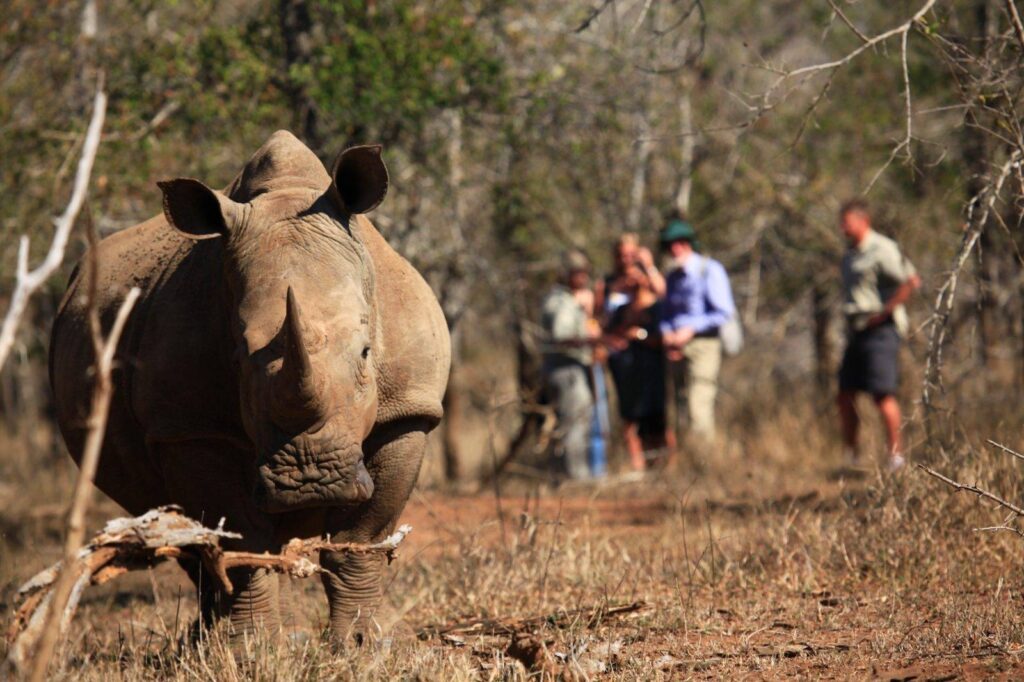
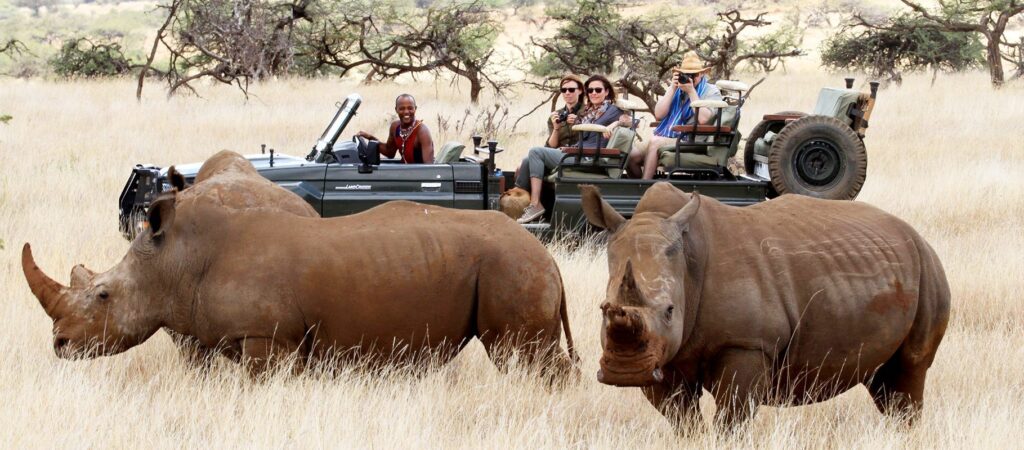
A guided bush walk changes the scale of the landscape: you notice the tracks, the dung middens, the birdsong, and the scent of crushed bush herbs that a vehicle blurs. Walks are led by armed rangers and often by Samburu guides, and at Loisaba the minimum age is 16. At some conservancies, walks can include an approach on foot to a habituated rhino, always at a distance and always under ranger control.
Night Drives
Night drives are usually banned in Kenya’s national parks, so their availability here is a real selling point. At Loisaba a two-hour night drive costs USD 120 per person with a minimum of two guests, and it is the best way to find leopards, genets, porcupines, bushbabies, and hyenas at work. Wrap up warmly: at this altitude the temperature drops sharply after sunset.
Horses, Camels, and Bicycles
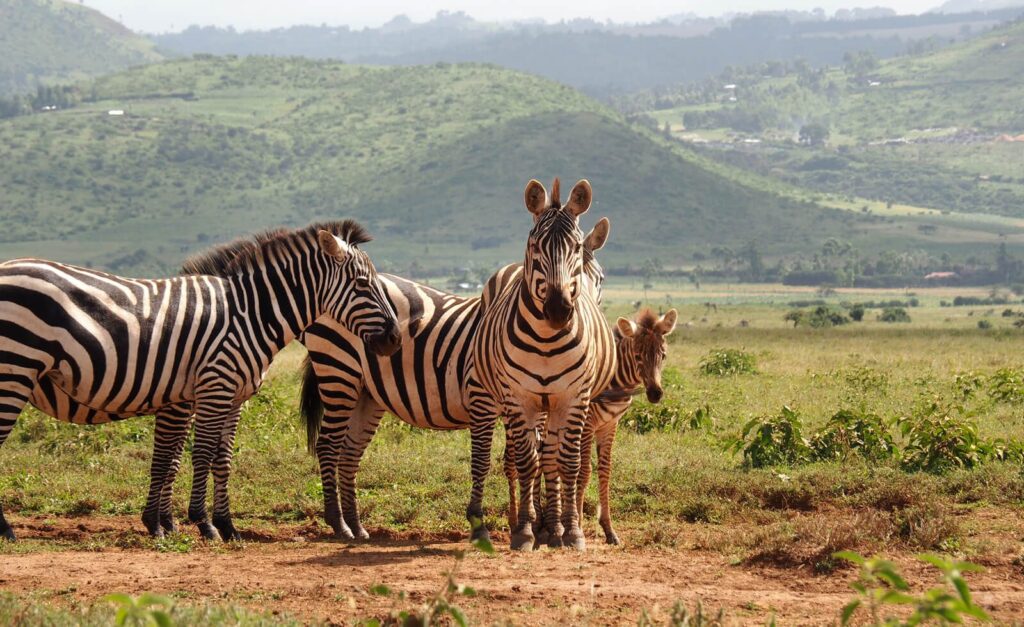
Riding a horse among giraffes and zebras, or walking beside a camel along the Ewaso Ng’iro river, is unlike any other safari format, and it is one of the few ways to get close to plains game without a vehicle. Camel treks normally last about two hours, and escorted e-bike excursions of up to eight hours cost around USD 110 at Loisaba. Riding is best for competent riders, so tell us your experience level in advance.
Sleeping Under the Stars
The Star Beds at Loisaba are the plateau’s signature experience: beds on wheels are pushed out onto private decks above a waterhole in the evening, so guests can watch the Milky Way appear with nothing but a mosquito net overhead. Guests who prefer walls can simply sleep indoors instead. It is romantic, unusual, and, in the dry season, spectacular.
Conservation and Community Experiences
Visits to the sniffer-dog unit (about USD 40 per person at Loisaba), Samburu village visits (about USD 50 for three hours), lion tracking with researchers, and rhino-monitoring days let guests see the conservation work their bed-night pays for. These are the experiences that make the plateau feel purposeful rather than merely beautiful, and they pair naturally with the conservation-focused itineraries we design under our Rwanda safari styles program.
Best Time to Visit the Laikipia Plateau
The best time to visit the Laikipia Plateau is the long dry season from June to October, with a second prime window from January to March, but the region is a genuine year-round destination because it is not tied to a migration. Daytime temperatures average 22 to 27°C, and nights fall to 10 to 13°C, so warm layers are essential every month of the year.

June to October: Long Dry Season and Peak Demand
Grass is shorter, roads are firm, and wildlife concentrates around permanent water, so game viewing is at its most predictable. The peak season from July to October coincides with the Masai Mara migration, leading to early sellouts of the best camps. It is the natural companion to Rwanda’s own long dry season of June to September.
January to March: Short Hot Dry Season
The weather is warm, dry, and clear, with excellent predator viewing and fewer visitors than mid-year. On cool, clear mornings, views of Mount Kenya are particularly stunning.
April, May, and November: The Green Seasons
Heavy rains make roads muddy and some camps close for maintenance, but the landscape turns emerald, young animals appear, and rates can be 30 to 50 percent lower than peak. Migratory birds arrive from October to April, so keen birders often prefer this window. Our tip for value-focused travelers: Rwanda gorilla permits are USD 1,500 all year with no low-season discount, so any savings on your combined trip come from Kenyan camps, making a shoulder-season Laikipia stay after a Rwanda trek a smart way to lower the total.
How to Get to the Laikipia Plateau: Flights, Roads, and Timings
Most luxury travelers reach the Laikipia Plateau by scheduled or chartered light aircraft from Nairobi’s Wilson Airport, a flight of about 45 minutes to Nanyuki and roughly one hour to Loisaba. Safarilink and AirKenya serve Nanyuki, Lewa Downs, Loisaba, and Samburu, and fares generally run USD 200 to 320 each way per person.
From Nairobi by Air
The detail that catches guests out is that safari flights leave from Wilson Airport, not Jomo Kenyatta International Airport (JKIA), where international flights land. Allow a cross-town transfer and at least three hours between an international landing and a Wilson departure, or, better, spend a night in Nairobi. Luggage on light aircraft is usually limited to soft-sided bags of roughly 15 to 20 kilograms, so pack accordingly. Safarilink publishes its Nanyuki, Lewa, and Loisaba services on its website.
From Nairobi by Road
Driving from Nairobi to Nanyuki takes 3.5 to 4.5 hours along the A2 through Thika, Karatina, and Nyeri, and the onward journey to a northern conservancy can extend a road transfer to around six hours in total. It is a scenic route through highland farmland and tea country, but few luxury guests choose it once they see the flight time.
From Kigali
Kigali to Nairobi is a nonstop flight of about 1 hour 30 minutes to 1 hour 40 minutes on Kenya Airways, RwandAir, or Brussels Airlines. We usually recommend overnighting in Nairobi rather than trying to connect to a Wilson flight on the same day. Guests coming from Volcanoes National Park should factor in the two- to two-and-a-half-hour drive back to Kigali for their onward flight.
| Route |
Typical time |
Notes |
| Kigali (KGL) to Nairobi (JKIA) |
About 1 h 30 to 1 h 40 nonstop |
Kenya Airways, RwandAir, Brussels Airlines |
| Nairobi Wilson to Nanyuki |
About 45 minutes by air |
3.5 to 4.5 hours by road via the A2 |
| Nairobi Wilson to Loisaba |
About 1 hour by air |
Around 6 hours by road |
| Nanyuki to Loisaba |
About 70 km |
Usually covered by air or camp transfer |
| Loisaba airstrip to Lodo Springs |
About 15 minutes |
Camp vehicle transfer |
How Much Does a Laikipia Safari Cost?
A luxury Laikipia safari typically costs between USD 500 and more than USD 2,500 per person per night, and the spread reflects exclusivity rather than quality: the difference between a USD 500 night and a USD 2,500 night is usually the number of vehicles per guest, a private guide, and whether you have a whole house to yourselves. Rates vary by 30 to 50 percent between peak and low season, and conservancy fees of USD 50 to 150 per person per day are typically included in the camp rate, as noted in the Laikipia Tourism cost guide.
| Cost item |
Approximate cost (USD) |
Notes |
| Entry-level luxury tented camps |
From about 300 to 500 pp/night |
Shoulder or low season; sharing |
| Top-tier camps and exclusive-use houses |
1,500 to 3,000+ pp/night |
Peak season and private-use bookings |
| Four-day, three-night fly-in packages |
From about 3,400 (Loisaba), 4,900 (Lewa), and 8,700 (Segera) pp |
Market listings, adult sharing, 2026 to 2027 |
| Scheduled flight, Wilson to Laikipia |
200 to 320 each way pp |
Charter flights cost considerably more. |
| Conservancy fees |
50 to 150 pp/day |
Usually included in rates |
| Night drive (Loisaba) |
120 pp for 2 hours |
Minimum two guests |
| Sniffer dogs / Samburu village / e-bikes (Loisaba) |
40 / 50 / 110 pp |
Published extras |
| Kenya eTA |
About 30 to 35 |
Apply at etakenya.go.ke |
Full-board rates normally include meals, house drinks, and guided activities, while premium wines, spa treatments, and private charter flights are extra. On a combined Rwanda and Kenya journey, we present a single itemized quotation, so you can compare each line against your budget. Rwanda’s gorilla permit is USD 1,500 per person, as outlined in our Rwanda vs. Uganda gorilla trekking comparison.
Where to Stay: Choosing a Luxury Camp on the Plateau
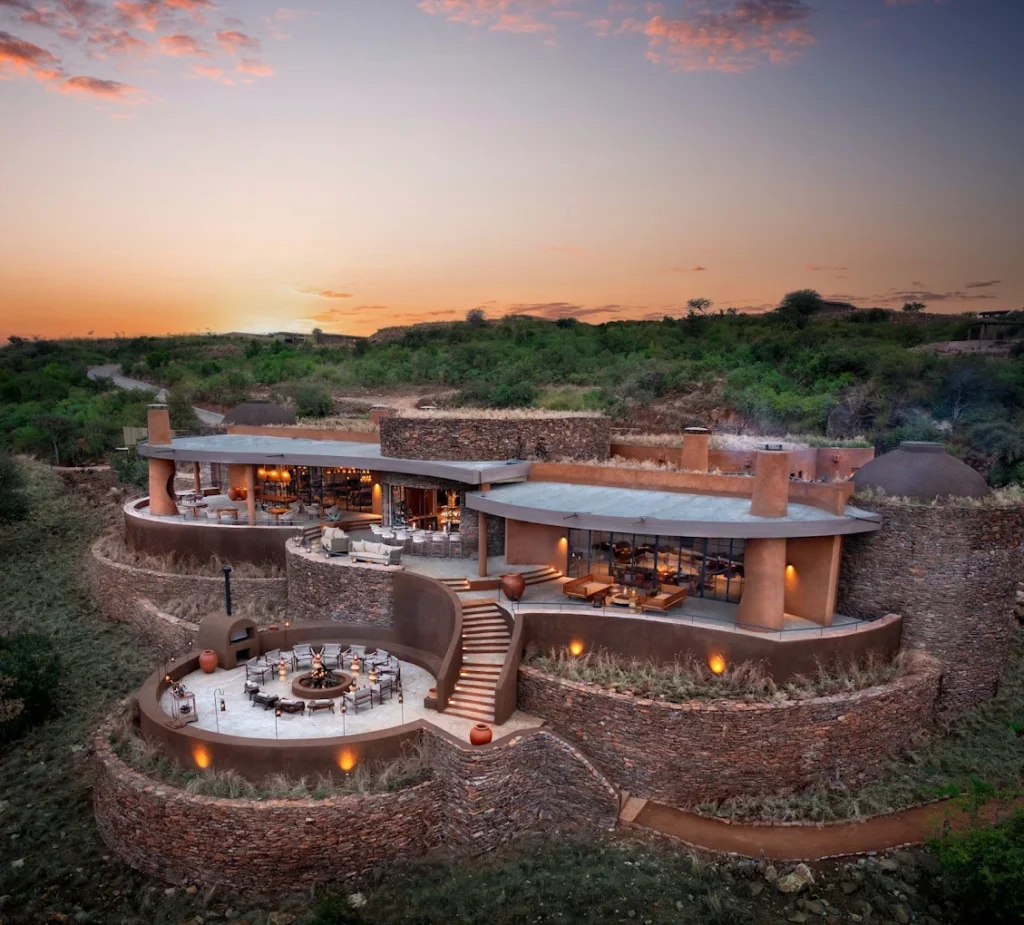
&Beyond Suyian Lodge
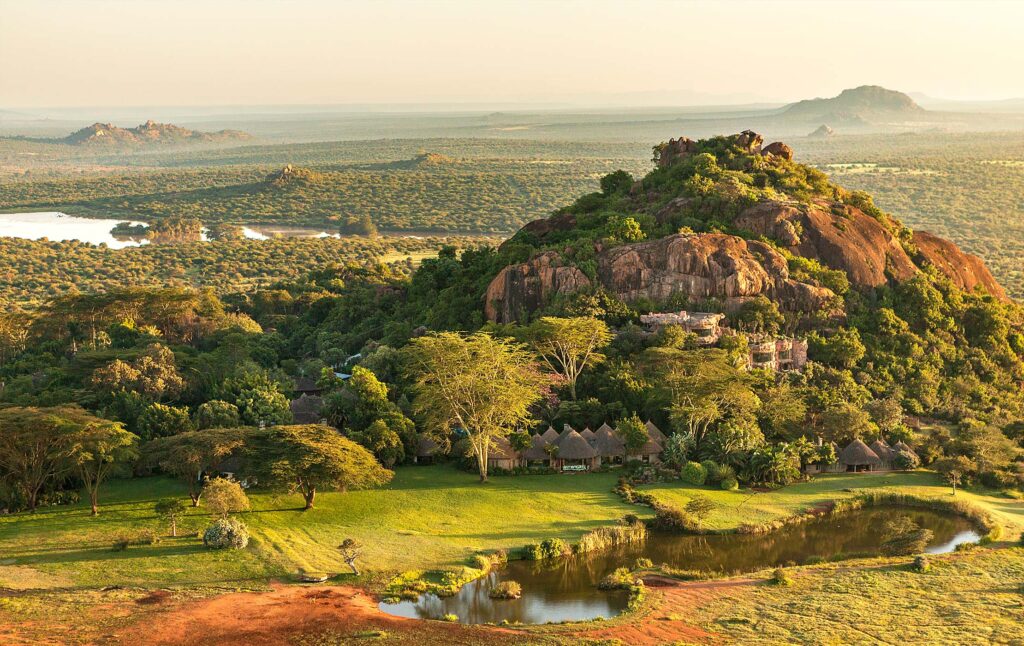
The right Laikipia camp depends on what you want to do rather than on stars or price, and the smartest itineraries split their nights between two conservancies to see different landscapes and species. Match your style to a place: families and rhino enthusiasts will be happiest at Ol Pejeta, where camps such as Serena Sweetwaters and Sanctuary Tambarare are set inside the conservancy; rhino and Grevy’s zebra devotees should look at Lewa Safari Camp, Kifaru House, Lewa Wilderness, or Sirikoi; adventurers and honeymooners will love Loisaba Star Beds or the eight-tent Lodo Springs; and guests who want complete privacy should ask about exclusive-use houses at Segera or Borana. For a five-night stay, three nights in the north followed by two in Lewa or Ol Pejeta is a well-balanced split. We plan each stay individually rather than defaulting to a single brand, in line with the private, profile-first approach outlined on our About Us page.
Combining the Laikipia Plateau with Rwanda’s Gorillas and Uganda
Laikipia combines easily with Rwanda because Kigali and Nairobi are barely an hour and a half apart by air, so a single itinerary can move from mountain gorillas to open plains within a day. A typical private journey spends three nights near Volcanoes National Park, flies to Nairobi, and then continues to Laikipia for three to four nights, with an optional Masai Mara extension at the end. Our Rwanda safaris guide explains the Rwanda side in detail, and our gorilla trekking overview covers the trek itself.
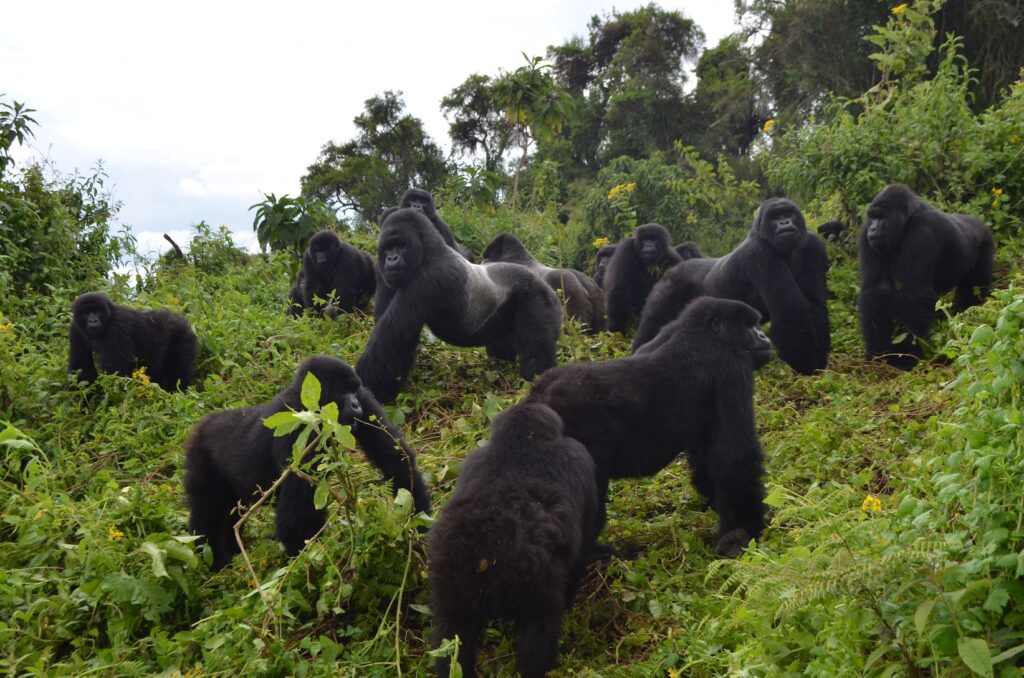
Always fix the Rwanda gorilla permit first, because Rwanda Development Board permits are issued in limited numbers each day and sell out months ahead, whereas Kenyan conservancy beds can usually be arranged around your permit date. In practice, this approach means we confirm the gorilla trek first, then build Nairobi and Laikipia backward and forward from it. If the trek is the emotional peak of your trip, finishing with Laikipia offers a gentler landing; if you would rather start gently and end with the gorillas, reverse the order.
Visas Across Three Countries
The East Africa Tourist Visa, priced at USD 100, covers Rwanda, Uganda, and Kenya for up to 90 days with multiple entries, but it must be issued by the country where you first enter the region, and it does not cover Tanzania. If you begin in Kigali, apply through Rwanda’s system; if you start in Nairobi, the Kenyan eTA is a separate document. Guests adding Uganda can compare their options in our Uganda safaris guide.
A Realistic Budget for the Combination
As a planning range, a ten- to twelve-night Rwanda and Laikipia journey at a luxury standard typically falls between USD 10,000 and USD 20,000 per person, depending on lodges, season, and whether you add the Masai Mara. That figure is built from the USD 1,500 gorilla permit, three nights at a Volcanoes National Park lodge, three to four nights in Laikipia, and the flights between them. Our safari experiences page shows how activities can be layered in.
Entry, Health, and Safety for a Laikipia Safari
Most international visitors need an approved Kenyan Electronic Travel Authorisation, or eTA, before boarding, which can be applied for on the official portal at etakenya.go.ke. Applications can be made up to 90 days ahead and at least three days before travel, and the fee is roughly USD 30 to 35 depending on processing charges.
Kenya’s New Travel Insurance Rule
In July 2026, Kenya gazetted a rule requiring foreign visitors staying under twelve months to hold travel health insurance with at least USD 50,000 of cover, including USD 20,000 for medical expenses and USD 25,000 for emergency medical transport. A High Court order later suspended implementation pending further hearings, as The EastAfrican reported, and the position was still developing. Whatever the outcome, we recommend comprehensive cover with air evacuation, which is standard practice for remote safari travel.
Health and Malaria
A yellow fever certificate is required if you arrive from a yellow fever-endemic country, and standard travel vaccinations should be discussed with a travel-medicine clinic. Laikipia camps sit at altitude, where malaria risk is lower than in the lowlands but not zero, so many travelers still take prophylaxis on medical advice. Tap water is not safe to drink; camps provide filtered or bottled water.
Safety on the Plateau
The conservancies themselves are well managed and secured, but Kenya’s overall advisory level is Level 2 on the US State Department site, and Australia’s Smartraveller notes that banditry and cattle rustling can occur in parts of the Central and North Rift, including Laikipia and Samburu counties. Flying between camps, avoiding self-drive, and traveling with an operator that has current ground information are the sensible responses, and they are exactly what a private itinerary provides.
What to Pack for the Laikipia Plateau
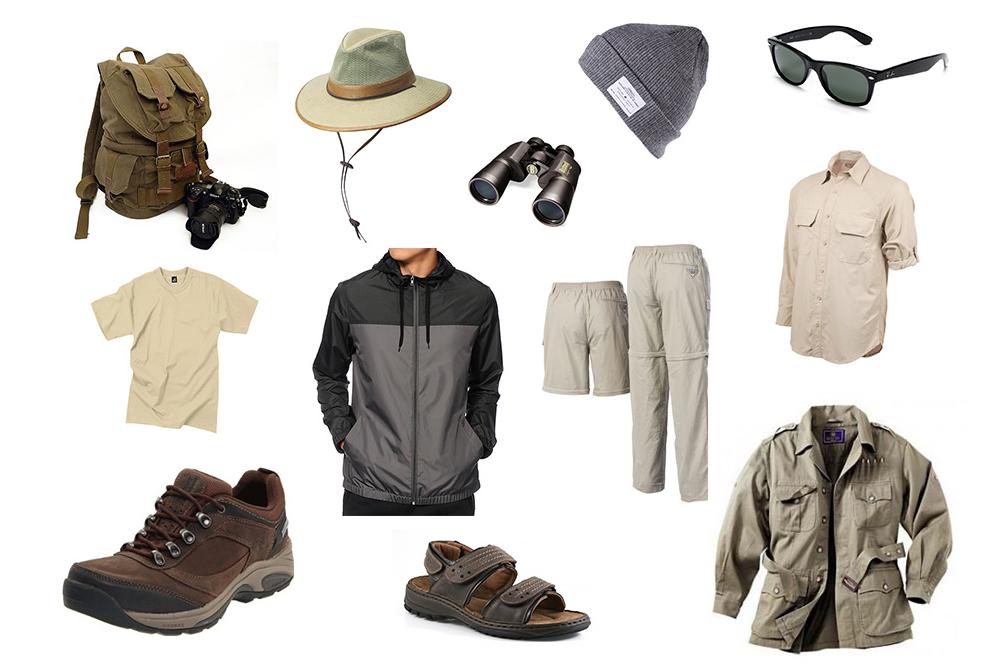
Pack for a cool, dry highland climate in layers: neutral khaki, olive, or tan clothing for game drives; a warm fleece or jacket for dawn and night drives; a waterproof shell for rainy months; a sun hat; sunglasses; and high-factor sunscreen. Closed walking shoes or light boots are best for walking safaris, and riders should bring their own helmet and boots if they have them. Bring a camera with a long lens, a headlamp, binoculars, and a soft duffel bag rather than a hard suitcase, since light aircraft have strict luggage limits. Avoid bright colors and camouflage patterns on foot. Carry a printed or offline copy of your eTA approval and small US dollar notes for tips.
What to Book in Advance
Book your camps and flights nine to twelve months ahead for July to October and the Christmas and New Year period, and three to four months ahead for the green season. Experiences that need advance notice include exclusive-use houses at places such as Segera, Star Beds nights at Loisaba, horse riding, private rhino-tracking walks, and guided visits to Ol Pejeta’s northern white rhinos. Confirm any Rwanda gorilla permit before anything else, and check your Kenya eTA and travel insurance requirements at least a month before departure. The advance-booking window is the difference between a first-choice camp and a compromise, which is why we recommend starting the conversation while your dates are still flexible.