Entering the Forest: The Trek to the Gorilla Family
The Terrain: What the Forest Is Actually Like
The approach to the Virunga Mountains forest begins at the park boundary, a clear demarcation between the cultivated agricultural land of the buffer zone and the dense, ancient bamboo and montane forest that rises steeply above it. The transition is immediate and dramatic: within fifty meters of the boundary wall, the air cools, the light changes, and the sounds of the village world are replaced by the forest’s own register bird calls, insects, and the occasional distant crack of a branch.
The terrain inside Volcanoes National Park varies and can be challenging. The lower bamboo zone, which most treks begin in, involves wide, well-worn paths through cathedral stands of giant bamboo that filter the light in extraordinary ways. As you climb into the mixed montane forest above the bamboo, the paths narrow and the gradient increases. Ground vegetation, nettles, wild celery, and stands of Lobelia wollastonii crowd the trail. Roots cross the path at ankle height. The soil after recent rain is a particular challenge: volcanic earth absorbs water quickly but releases it as a dense, sticky mud that grabs at boot soles with each step. This section is where trekking poles, gaiters, and a porter all earn their place.
At higher elevations, above approximately 2,800 meters, the forest opens into more dramatic Afro-alpine habitat, with giant groundsels, open moorland patches, and the kind of wide views across the valley that remind you, in moments of physical effort, why you came. The Susa family and one or two others range at these higher elevations; treks to them involve the most demanding sections of terrain. The rewards are proportionate.
How Long Does the Gorilla Trek Actually Take?
Trek duration is genuinely variable and genuinely unpredictable on any given day. The tracking scouts who sleep near the forest and follow the gorilla families from First Light radio the family’s morning position to the briefing team before 06:00. On days when a family is resting low and close to the boundary, trekking groups can be with the gorillas in under an hour of total hiking time. On days when a family has moved overnight to higher terrain, which they do freely and unpredictably, following food sources, social dynamics, and conditions invisible to the tracking team until the scouts physically locate them the same family can require three or four hours of hiking before the trackers’ call signals you to stop and prepare.
The Rwanda Development Board provides honest guidance on typical trek durations, and guides communicate the morning’s tracking report at the briefing. But no operator, guide, or ranger can guarantee the duration in advance and this unpredictability is, paradoxically, one of the most powerful dimensions of the experience. The gorillas are wild animals that live according to their own instincts. The variability of the trek is not a planning failure; it is evidence of authenticity. What can be said with confidence is that the success rate for locating habituated gorilla families in Volcanoes National Park is above 98 percent on any given trekking day, across all seasons.
The Role of Trackers and Rangers in the Forest
You will be accompanied in the forest by two principal personnel beyond your guide: a lead ranger armed with a rifle (for wildlife protection rather than visitor protection, the firearm is present for encounters with forest buffalo or elephant, not gorillas), and one or two tracking scouts who maintain position in front of the group and communicate with the advance team by radio. The trackers are extraordinary professionals many have been working in this forest for ten to twenty years and possess a knowledge of gorilla behavior, forest terrain, and seasonal movement patterns that no amount of formal training can substitute. Watch them work. The way they read bent vegetation, displaced soil, and fresh dung to locate an animal that may be a kilometer ahead in dense forest is one of the quiet revelations of the trek day.
When the trackers make contact with the gorilla family and confirm that the group is settled, they call back to the guide. At this point, your guide will stop the group, ask everyone to leave their larger packs with the porters and rangers at the last clearing, check that cameras are ready and that flashguns are disabled, and lead the final approach often through particularly dense vegetation to the encounter site. The last fifty meters before the gorillas are often the most physically demanding and the most emotionally charged of the entire day.
The Gorilla Encounter: What Happens in the One Hour With the Family.
The Moment of First Contact
There is no set moment when the gorillas become visible, as the family does not arrange itself for your arrival. You may hear them before you see them the deep, rumbling belch vocalisation that silverbacks use as a contact call, or the crashing of branches as juveniles play in the canopy above. You may smell them first a warm, musty scent, distinctly animal but not unpleasant, that registers in the nose before the eye has located the source. Or you may simply look up from watching your footing on a root-crossed section of trail and find yourself three meters from a juvenile gorilla sitting in a gap in the vegetation, regarding you with an expression of calm and complete composure that stops the breath entirely.
The guide signals the group to stop, spread slightly, and crouch where possible. You are now in the presence of the gorilla family. The one-hour observation period begins from the moment the lead ranger confirms visual contact with the first member of the family. From this point, your only obligations are to stay at least seven metres from the animals, follow the guide’s positioning instructions, and be fully present for what is happening in front of you.
What the Gorilla Family Does During Your One Hour
Mountain gorillas, unlike many large African mammals that show visible stress in the presence of human observers, genuinely habituate to trekking groups. The habituation process gradually exposes wild gorilla families to human presence over two to five years, until they treat visitors as an unremarkable feature of their environment, making it one of the most painstaking and scientifically rigorous programs in wildlife conservation. As a result, the gorilla family you spend an hour with will likely behave as if you are barely present.
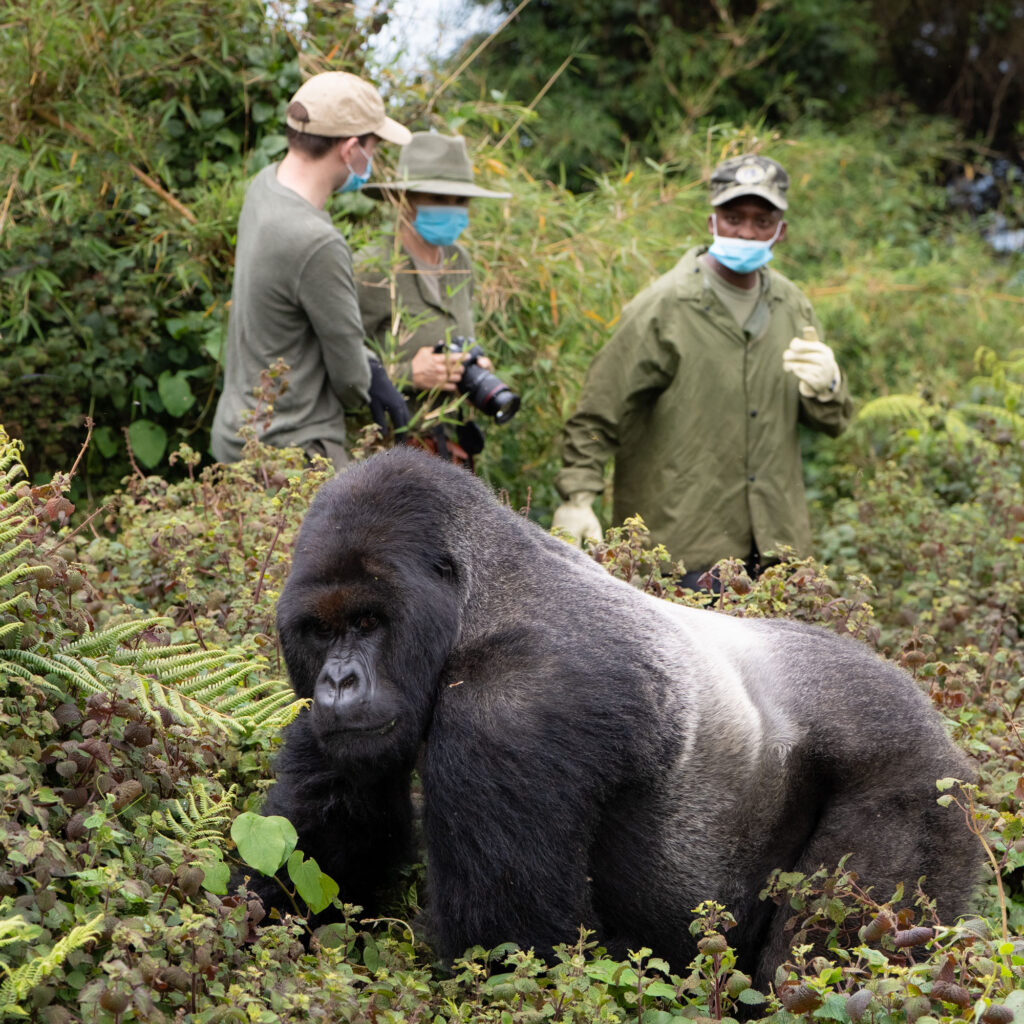
A typical morning with the family involves a range of behaviors that, precisely because they are so ordinary, feel so profound. Silverbacks, the adult males, identified by the silver saddle of hair across their back and haunches, typically spend the morning session grazing, resting between feeding bouts, and occasionally repositioning. Their size, which routinely exceeds 200 kilograms and can approach 250 kilograms in large dominant males, is visible from a distance but becomes fully comprehensible only at close range. The chest broad, muscled, and hairless on mature males rises and falls with a weight and deliberateness that communicates both power and complete calm.
Adult females with infants are among the most compelling subjects: the infant’s face, wide-open and unguarded with curiosity, is the most recognisably human expression you will encounter in any wildlife encounter. Juveniles between three and eight years old are frequently the most active and least inhibited members of the group, playing in the vegetation, chasing each other through the undergrowth, and occasionally approaching the human group with an investigative boldness that the adult females watch with amused tolerance. These are the moments that most frequently appear in visitors’ descriptions of their encounter: the juvenile that walked directly through the group; the blackback male that sat two meters from the trekkers and spent ten minutes picking apart a stalk of wild celery; and the silverback’s direct, steady gaze that lasted thirty seconds and said everything.
The Seven-Metre Rule and When the Gorillas Break It
Rwanda’s gorilla trekking regulations require visitors to maintain a minimum distance of seven meters from all gorilla family members at all times. This rule serves a dual purpose: it reduces the risk of respiratory disease transmission (gorillas are 98.7 percent genetically identical to humans and share most of our respiratory vulnerabilities), and it minimizes the potential for stress responses in the animals. The rule is enforced without negotiation.
What the rule cannot enforce is the gorillas’ own spatial preferences. Habituated gorilla families treat the seven-meter zone as the visitors’ problem, not theirs, and will walk through, around, or directly toward the human group without hesitation when their movement patterns require it. On the majority of treks, at least one gorilla comes closer than the regulation distance of their own volition frequently much closer. Guides will instruct the group to step back slowly and create space; you will do so slowly and with your heart in your throat, while a 200-kilogram silverback crosses within arm’s reach. These are the moments that no wildlife photographer on earth can adequately prepare you for.
The One-Hour Limit: Why the Clock Matters
The one-hour observation window is strictly enforced by the ranger accompanying your group, who begins timing from the moment the family is located. When the hour expires, the ranger signals the group to begin withdrawal slowly, facing the gorillas until a safe distance is established, then turning to retrace the approach route. The time limit exists to minimize cumulative stress on the gorillas from daily human contact, to reduce disease transmission risk, and to maintain the program’s sustainability across the twelve families and their long-term behavioral health.
Most visitors find that the hour, which felt impossibly short during the planning phase, actually passes at a pace that is neither too fast nor too slow when you are in the forest with the family. The watching itself is meditative: there is nothing to do but observe, and the quality of attention the gorillas command is total. What almost every visitor reports is not that the hour was too short, but that the transition back to the ordinary world after the walk down through the forest, the trailhead, and the lodge vehicle requires a significant adjustment that the mind is not entirely prepared for.
Photography During the Gorilla Trek: What to Know Before You Pick Up the Camera.
Photography is permitted and unrestricted in terms of the number of shots or the type of camera equipment, with one absolute exception: flash photography is completely and strictly prohibited at all times, in all circumstances, without exception. A flash discharge at close range in a habituated gorilla family causes distress that compromises both the animals’ well-being and the safety of the group. Flash-triggered aggression is a documented phenomenon. The prohibition is not precautionary; it is based on observed consequences. Disable your flash before entering the forest and confirm it is disabled before every shooting session.
The practical photographic challenge of gorilla trekking is light. The dense forest canopy, the thick understory vegetation, and the volcanic cloud cover that frequently characterizes the Virunga mornings all conspire to produce extremely challenging low-light conditions. The gorillas are not cooperative subjects in the way that open-savannah wildlife can be; they move, they are partially obscured, and they sit in backlit conditions, with a halo of bright sky behind them and deep shadow on their faces. A camera body with strong high-ISO performance (ISO 3200 and above without objectionable noise) and a fast prime lens, a 50mm f/1.4, 85mm f/1.8, or 100mm f/2.8, gives you the best chance of capturing sharp images in the available light. Zoom lenses with f/4 or f/5.6 at the telephoto end will struggle in the forest interior.
Video is fully permitted and, for many visitors, produces the most emotionally resonant record of the encounter, not because moving images are technically superior, but because the sounds of the forest and the gorilla family add a dimension of presence that still photography cannot fully replicate. Smartphone cameras have improved to the point where excellent video and passable stills are achievable in decent light. In poor light, a dedicated mirrorless or DSLR body is genuinely superior. Whatever equipment you bring, make sure to charge spare batteries and load fresh memory cards the night before. The hour does not pause for equipment failures.
For travellers investing in a photography-focused Rwanda safari, a second gorilla trekking permit on a consecutive day, whether encountering the same or a different family, is the single most effective strategy for improving image quality. The emotional impact of the experience inevitably absorbs the first encounter. The second, with the shock of proximity tempered by prior experience, allows a more deliberate and technically focused approach.