Multi-Country Safari Routes by Trip Length.
The best multi-country safari routes are built around no more than two countries and four or five bases, and the right length is the one that leaves at least two full nights in every place you sleep. The sample routes below are starting points that we adapt to your dates, permits, and preferences. Everyone begins and ends in Kigali or another major international gateway and is designed as a fully private journey with your guide and vehicle.
Ten days: Rwanda gorillas with a Kenya or Zanzibar finish
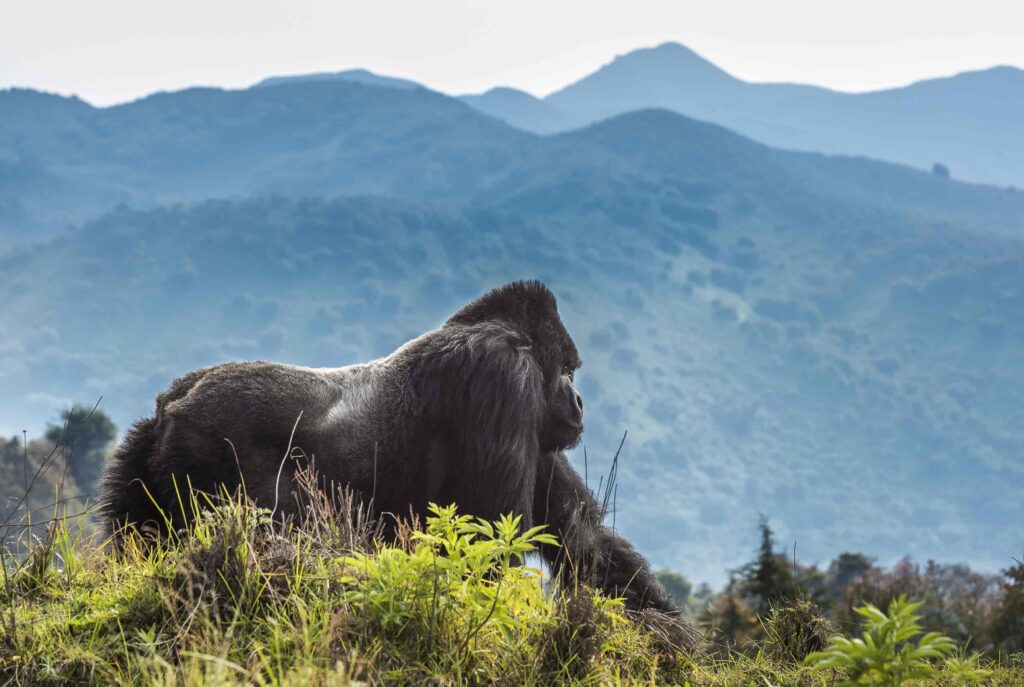
A ten-day route is tight but excellent when the priorities are clear. Spend three nights in Rwanda, arriving in Kigali, driving to Volcanoes National Park, and trekking gorillas on day two, with an optional golden monkey trek or Lake Ruhondo boat excursion the following morning, then flying out of Kigali on day four. Continue to Nairobi and on to the Masai Mara for four nights, then finish with two or three nights at the coast or an extra night in the Mara. It is a lean schedule with three or four flights, and it works best for travelers who value time over variety. Alternatively, shift the balance to Rwanda and use our five-day Gorilla and Golden Monkey Discovery Safari for this section.
Twelve days: Rwanda and the Serengeti
Twelve days is the most requested length for gorillas and the Great Migration. Four nights in Rwanda, covering Kigali, Volcanoes National Park, and a forest or lake extension, are followed by a connecting day, then six nights in the Northern Circuit of Tanzania, typically two nights each in two different regions of the Serengeti chosen to match the migration’s position, and one night on the Ngorongoro rim. This itinerary is the format in which sequencing is most critical. Because the herds follow rainfall, the position of the migration in your month decides which Serengeti region you sleep in, and the camps in the right region book out first. We discuss this topic in the seasons section below.
Fourteen days: Rwanda, Uganda, and the primate trail
Fourteen days lets you take a genuinely profound look at the primates of the region. Begin with five nights in Rwanda, combining gorillas at Volcanoes with chimpanzees in Nyungwe, an itinerary similar in spirit to our eight-day Luxury Rwandan Primate Safari. Then cross at Cyanika into Uganda for a second gorilla trek in Bwindi and a few nights in a savannah park, such as Queen Elizabeth, for boat safaris and tree-climbing lions before flying out of Entebbe. The route is largely overland, so it is slower, but it is the most forgiving on baggage limits and flight changes, and the scenery from the Rwandan hills to the Kigezi highlands is spectacular in its own right.
Sixteen days: The complete East Africa journey
A sixteen-day itinerary is the expression of a complete East African safari. Plan for five or six nights in Rwanda, including both Volcanoes and either Akagera or Nyungwe, followed by six or seven nights in either Tanzania or Kenya, and then three nights on Zanzibar or the Kenyan coast. Each leg is long enough that you stop living out of a bag, and the beach finale is long enough to be restorative. This route offers the best opportunity to take advantage of the Rwanda low-season permit discount, as it requires only two qualifying nights in Akagera or Nyungwe, which a sixteen-day itinerary includes anyway.
The Best Time for a Multi-Country Safari in East Africa
The best time for most multi-country safaris is June to September, when Rwanda’s dry season overlaps with the Mara migration crossings and the Serengeti’s northern sector, although the right month depends on which wildlife you most want to see. East Africa’s two rainy seasons, the long rains from March to May and the short rains in November, bracket two dry windows, and understanding how each country’s calendar lines up is the key to a successful itinerary.

June to September: the classic window
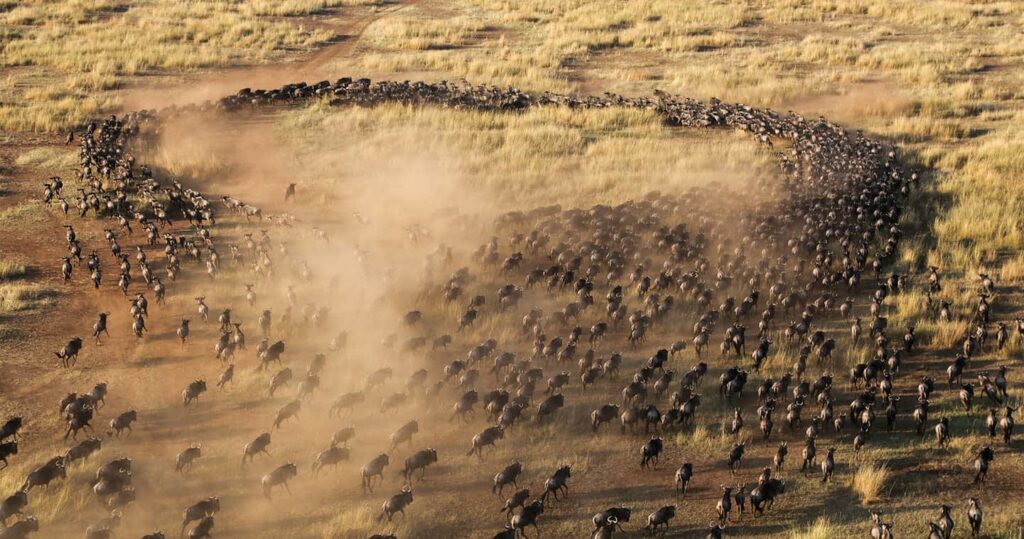
Rwanda’s long dry season, from June to September, offers firmer trails and the most comfortable gorilla trekking, while Kenya’s Masai Mara and Tanzania’s northern Serengeti reach peak migration activity from roughly July through October. This is by far the most popular period for combined itineraries and the most competitive for gorilla permits and small camps. We recommend booking six to twelve months in advance for these months. September is a favorite among guides in the northern Serengeti, as crossings remain active while visitor numbers are noticeably lower than in August. Government fees in the Mara rise to USD 200 per adult per day from July to December under the county’s seasonal structure, so the price of peak migration season is visible in the cost sheet as well as the calendar.
December to March: calving season and a second dry window
December to February is Rwanda’s short dry season and an excellent window, and it coincides with calving season on the southern Serengeti plains around Ndutu, which many guides rate as the best predator viewing of the year with fewer vehicles than the July to September crossings. This is a particularly strong combination for gorillas in Tanzania and also for gorillas in Kenya’s Laikipia, which is a year-round destination. Be aware that the Christmas and New Year period carries lodge supplements and is the second hardest time for permits.
April, May, and November: the green season and double discounts
The wetter months are the best-kept secret of luxury multi-country safaris, because they offer real savings and quieter parks. Rwanda’s Development Board offers a 30 percent discount on a gorilla permit, bringing it from USD 1,500 to USD 1,050, from November to May for guests who spend at least two nights in Akagera or Nyungwe, with the nights and one paid activity documented. Uganda has also introduced reduced-price permits for April, May, and November, reportedly USD 600 instead of USD 800. In other words, a November or April-to- May itinerary that begins in Rwanda and continues to Uganda can save a meaningful amount on both permits. The trade-off is mud on forest trails and heavier rain, so good boots, gaiters, and a flexible attitude are essential. Kenya and Tanzania in these months offer their lowest lodge rates of the year, lush landscapes, and excellent birding, but the migration is dispersed rather than concentrated at river crossings.
| Month |
Rwanda gorillas |
Tanzania (Serengeti) |
Kenya (Masai Mara) |
Notes |
| January-February |
Excellent, short dry season |
Calving season, southern plains |
Resident wildlife, quieter |
Good Laikipia rhino tracking |
| March-May |
Wet, muddy; Rwanda discount Nov-May |
Long rains, lowest rates |
Long rains, lowest rates |
Best value: Uganda reduced permits in Apr-May. |
| June-September |
Peak dry season |
Western Corridor to northern crossings |
Migration arrives; crossings Jul-Oct |
The book allows for 6-12 months ahead. |
| October |
Short rains begin |
Northern Serengeti is still active. |
Herds linger; fees are USD 200. |
Fewer vehicles than August |
| November |
Short rains; discount available |
Herds turn south. |
Light afternoon showers |
Underrated value month |
| December |
Short dry season |
Herds back on the southern plains |
Resident wildlife |
Festive supplements apply. |
Getting There and Moving Between Countries: Flights, Borders, and Timings
On a multi-country safari, travel between countries is almost always done by a mixture of scheduled flights, light aircraft, and, in the case of Rwanda and Uganda, an overland border crossing; the timings below are what we plan around. Nearly all long-haul travellers reach the region through Kigali, Nairobi, or Entebbe, and from Kigali the connections are good: Kigali to Nairobi takes roughly one and a half to two hours, Kigali to Entebbe about an hour, and RwandAir’s network also includes Kilimanjaro and Mombasa, with a direct Kigali to Zanzibar service that began at the end of November 2025. Schedules do change, particularly after the disruption many carriers experienced during the 2026 Ebola outbreak, so we confirm current flights at the time of booking rather than relying on a timetable from months earlier.
Crossing from Rwanda into Uganda by road
The road crossing is one of the most useful and least understood pieces of information for planners. The journey from Kigali to Bwindi usually takes four to five hours via either the Cyanika border near Kisoro, best for the southern Rushaga and Nkuringo sectors, or the Katuna border near Kabale, which serves the northern side. The drive from Kigali to Cyanika alone is about three hours. Your Rwandan guide hands you over to a Ugandan driver-guide at the border, which is the standard arrangement because vehicles and driver licenses are country-specific. Uganda is one hour ahead of Rwanda, which can be confusing when planning trek start times and flight departures. Because a gorilla trek can run for several hours, we never schedule a flight out of Kigali on the day you trek in Bwindi unless it leaves late in the evening, and we advise not leaving before about ten at night. The Entebbe route is an entirely unique proposition, with a drive of eight to ten hours from the airport to Bwindi, unless you take a light aircraft to an airstrip near the forest.
Flying between Kenya and Tanzania is possible.
The cleanest way to move between Kenya’s Mara and Tanzania’s Serengeti is by scheduled light aircraft, using a regional hub such as Nairobi or Arusha. An overland border crossing at Namanga is possible, but the final roads turn from tarmac to gravel and add significant time. Within each country, light aircraft connect park airstrips, and the roughly 15-kilogram soft-bag luggage limit matters from the first day. Our Tanzania guide notes that the overland run from Arusha to the Serengeti’s Seronera area is about 325 kilometers and around eight hours, which is why luxury itineraries default to flying. In Kenya, domestic safari flights depart from Nairobi’s Wilson Airport, not the international terminal at Jomo Kenyatta, which can be 40 minutes to an hour apart in traffic. Allow a three-hour connection at minimum, or, much better, sleep a night in Nairobi.
Connection buffers that actually work
Our rule is simple: never plan a gorilla trek, a migration game drive, or a morning light aircraft departure on the same day as an international flight, and build in at least one flexible day somewhere in the middle of the itinerary. Gorilla treks occasionally run late. Light aircraft are subject to weather and sometimes combined with other guests’ schedules. A buffer costs the price of one extra night and saves the cost of a missed connection, which is why we think it is the best money in the budget.
Visas, Permits, and Health Entry Rules for Multi-Country Safaris
Visas are the part of multi-country planning that goes wrong most often, because East Africa does not have a single visa that covers every country you might visit. The East Africa Tourist Visa costs USD 100, is valid for 90 days with multiple entries, and covers Kenya, Uganda, and Rwanda only. It must be issued by the country where you first enter the region, and it is only valid while you remain inside those three countries. The Ugandan immigration authority lists the requirements on its official portal, including a passport valid for at least six months, a photograph, a yellow fever certificate, a return ticket, and an itinerary. You can read the details on the official Uganda immigration guide.
Tanzania and Kenya are handled separately.
Tanzania sits outside the joint visa and requires its own visa, priced at USD 50 for most passport holders and USD 100 for United States citizens, which can be obtained online or on arrival at Kilimanjaro for eligible nationalities. A single Tanzanian visa covers both the mainland and Zanzibar, though Zanzibar has introduced a separate insurance and tourism levy that you should confirm. Kenya replaced its visa with an Electronic Travel Authorization in January 2024, applied for online through the official Kenya eTA portal at roughly USD 30 to 34, with processing normally taking two to three working days, although we recommend applying at least two to four weeks ahead. Citizens of East African Community states are exempt from this requirement. If your route is Rwanda, Kenya, and Tanzania, then you might hold an East Africa Tourist Visa for the first two and a separate Tanzanian visa for the third, or buy separate visas for each. We check which is cheaper and simpler for your passport.
Yellow fever and other health documents
Carry a yellow fever vaccination certificate on every multi-country trip. Rwanda requires it from travellers arriving from endemic countries, Uganda’s joint visa application asks for it, and Tanzania and Kenya require it from travellers arriving from or transiting through endemic countries, which include Rwanda and Uganda. Because you will be crossing between those countries, the certificate is effectively mandatory in practice. Beyond that, hepatitis A and B, typhoid, and rabies are commonly recommended for East Africa, and malaria prophylaxis is generally advised for lower-elevation areas such as Akagera, the Serengeti, and the Mara, while the high-altitude gorilla zone has a lower risk. See a travel medicine specialist four to six weeks before departure, and use the CDC’s travel health guides or your national equivalent for current notices.
Permit rules to know before you book
Both gorilla permits are tied to one person, one date, and, in practice, one park sector. Rwanda’s permit is non-refundable once issued, and rescheduling is subject to the Rwanda Development Board’s conditions and charges. In Uganda, permits are sector-specific, and foreign non-residents must reportedly book through a licensed Ugandan tour operator rather than directly. The minimum age for gorilla trekking is fifteen in both countries. These are the details a coordinating operator should be handling for you in writing before you pay a deposit.